


Cart
0
How to Create a Calm and Clean Bedroom Atmosphere
Some bedrooms seem to lower the volume the moment you step inside. The bed looks welcoming without disappearing under a mountain of cushions, the surfaces are clear, the lighting is soft, and nothing sits in the corner quietly waiting to be tidied. Even when the room is small, it feels like there is room to breathe.
It is tempting to assume those rooms belong to people who own less, have more square footage, or live in a household where nobody ever drapes yesterday's jeans over a chair. In practice, a calm bedroom has far more to do with what is visible, how easily everyday belongings can be put away, and whether the furniture gives the room enough space to work.
That is encouraging news if your bedroom contains rather more than a bed, one perfectly placed book and a vase of eucalyptus.
What Makes a Bedroom Feel Calm and Clean?
A calm, clean bedroom usually brings together generous storage, clear surfaces, a coherent colour palette, layers of soft texture, comfortable bedding and warm evening lighting. Cutting down on visible clutter makes the single biggest difference, because it gives your eye fewer things to process the moment you walk in. Hidden storage lets you get that effect without becoming a minimalist.
The difference between owning less and seeing less matters enormously.
Most households genuinely need spare bedding. You need clothes, chargers, towels, shoes and all the other things that find their way into a bedroom whether you invite them or not. The room does not become peaceful because you reluctantly binned half of them. It becomes peaceful when those belongings have a sensible place to live.
Start With What You Actually See From the Doorway
Before you touch the colour scheme or buy anything new, stand in the bedroom doorway and notice what pulls your attention first.
It might be the clean laundry that has been waiting three days to complete its final journey into the wardrobe. It might be shoes under the bed, skincare bottles spread across the dressing table, charging cables on both bedside tables, and a couple of bags occupying a corner because they have never been given a home.
No single one of those things is a problem. It is the accumulation that makes a room feel busy.
Clearing visible surfaces is therefore the fastest route to a different atmosphere. Begin with one bedside table rather than attempting to reorganise the whole room in a single heroic afternoon. Keep the lamp, the book, the glass of water, whatever you genuinely reach for, then rehome everything that has quietly collected around them.
Once one surface is clear, move on to the next. Many people find the room feels noticeably different before anything decorative has changed at all, which is a useful reminder that the wallpaper was rarely the problem.
Let Your Bed Do the Hard Work of Bedroom Storage
The bed takes up more floor space than any other piece of bedroom furniture, yet in most rooms that huge footprint offers somewhere to sleep and very little else.
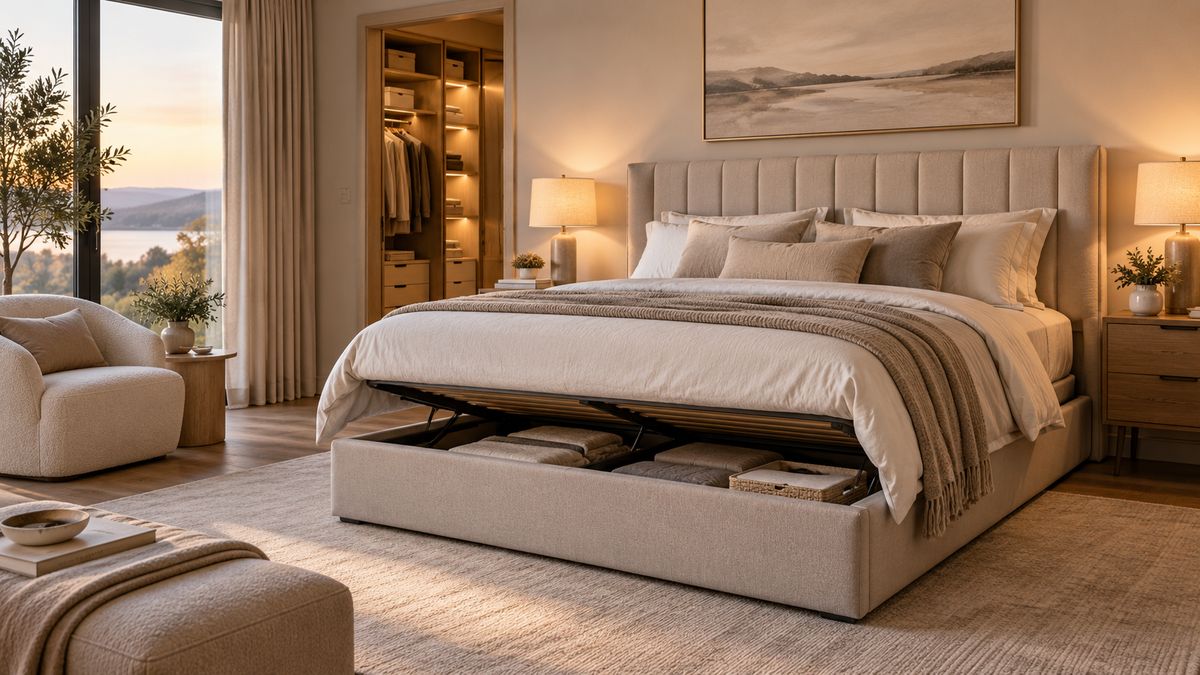
An ottoman storage bed changes that completely by turning the space under the mattress into a hidden storage compartment. Instead of squeezing another chest, basket or stack of plastic boxes into the floor space you have left, bulky belongings disappear underneath something the room needed anyway.
This is especially valuable for the awkward category of possessions that swallow space but are only needed occasionally. Winter duvets, spare pillows, bedding sets, towels, seasonal clothes, shoes and suitcases all fit comfortably beneath a lifting base. Moving even a few of those items under the bed takes pressure off wardrobes and drawers, and in a smaller room it can remove the need for an extra piece of storage furniture altogether.
Why Ottoman Beds Suit Small Bedrooms So Well
Our ottoman beds are built around exactly this problem. The gas-lift base opens smoothly, the storage space runs the full length of the bed, and the upholstered frame keeps everything looking soft rather than utilitarian.
A bedroom stays calm far more easily when the furniture helps you maintain it, rather than demanding another set of boxes and baskets to handle everything the furniture could not hold.
Choose a Bed That Does Not Compete With the Rest of the Room
Because the bed is usually the largest object in the room, its proportions and design have an outsized influence on the atmosphere.
If you are aiming for something clean and contemporary, a simple upholstered frame adds softness without adding visual noise. Straight lines, restrained panelling and uncomplicated headboards sit quietly in the space, which leaves you more freedom with bedding, lighting and artwork. Our upholstered bed frames and divan beds both work well here.
That does not mean decorative beds and calm interiors are incompatible. A winged or buttoned headboard can look beautiful in a restful room, particularly if you want something closer to boutique hotel luxury. The trick is deciding in advance where the visual interest is going to come from.
If the bed has an elaborate headboard, the wall behind it probably does not also need patterned wallpaper, three pieces of artwork and a pair of statement pendants. Equally, if you have chosen a very simple bed, the room can comfortably carry more personality elsewhere. Let one or two things do the talking instead of inviting everything in the room to compete for the microphone.
Build a Colour Palette Rather Than Collecting Colours You Like
Bedrooms usually become visually busy not because any one colour is wrong, but because too many unrelated colours have gradually arrived in the same room.
You liked the blue curtains. The grey bed seemed sensible. The beige carpet came with the house. Then the pink cushions appeared, followed by black bedside tables and a patterned duvet cover, each of which looked perfectly reasonable on its own.
Together, they leave the room feeling unsettled.
A calmer approach is to pick two or three broad colour families and let variations of them repeat through the space. Warm white, putty and natural oak create an understated modern bedroom. Cream, sage and soft brown feel warmer and more organic. Charcoal with warm white and timber gives you stronger contrast without introducing lots of different colours.
The shades do not need to match exactly, and arguably they should not. A room containing five perfectly matched beige pieces can end up looking like a showroom display rather than somewhere anyone actually sleeps. What you are after is a sense that the colours belong to one another.
Calm Does Not Have to Mean Pale
Cream bedrooms photograph beautifully, but there is no rule saying restful rooms must be light.
Darker colours create an exceptionally cocooning bedroom when they are used with a little restraint. A charcoal upholstered bed against warm off-white walls gives depth and definition without darkening the whole space. Midnight blue does much the same job while bringing in more colour, and muted green has enough character to stop a neutral room feeling anonymous.
In a smaller bedroom you may still prefer lighter upholstery, simply because it carries less visual weight across a large headboard. Our fabrics run from soft neutrals such as cream, mink and stone through to deeper greys, blues and charcoal, so there is scope to suit both the room and your taste.
Whichever direction you take, order samples before you commit. Upholstery looks noticeably different under real bedroom lighting than it does on a backlit phone screen, especially with textured weaves and velvet, where the surface shifts as the light moves across it. You can request them from our fabric swatches page.
Use Texture So a Neutral Bedroom Never Feels Flat
The risk with the phrase calm bedroom is that it quickly becomes shorthand for make everything beige.
A restrained palette only works when there is enough variation elsewhere to hold your interest, and texture is the easiest way to achieve that.
Picture a room with a linen upholstered bed, crisp cotton bedding, a wool throw, timber bedside tables and a soft rug underfoot. The colours might all sit within a narrow band of cream, stone and brown, yet the room never feels flat, because every material catches the light and responds to touch differently.
Upholstered beds are particularly useful here, since they introduce softness across one of the largest surfaces in the room. Our finishes include linen, velvet, plush and teddy fabric, so the same broad colour can create quite different effects. A putty linen bed feels relaxed and natural, while a similarly neutral velvet makes the room feel considerably more luxurious. Neither is more calming than the other. It is simply a question of whether you want understated simplicity or something softer and more hotel-like.
Leave Some Empty Space in the Room
One of the stranger habits in interior design is our determination to find an object for every available gap.
There is space at the foot of the bed, so surely a bench belongs there. An empty corner could take an occasional chair. The wall above the chest of drawers is blank, so artwork must be required. Then a decorative basket arrives, because apparently even the floor cannot be left to its own devices.
Eventually the room holds everything it could possibly fit, and almost no space around any of it.
Empty space is not wasted space. It gives the eye somewhere to rest and makes the furniture you did choose feel deliberate.
If a chair is genuinely used for reading, keep it. If its main function is holding clothes that are not clean enough for the wardrobe but not dirty enough for the laundry basket, it may be contributing less than you hoped. The same test applies to end-of-bed furniture, extra shelving and decorative baskets. If removing something makes the room feel larger and you do not miss its function, you have your answer.
Closed Storage for Everything That Is Not Decorative
Open shelves look wonderful holding three books, a ceramic vase and one beautifully folded blanket. Real life tends to have other plans for them.
Chargers arrive. Hair products multiply. Post appears. A packet of paracetamol joins the display, followed by loose jewellery and an instruction manual nobody is willing to throw away in case the appliance develops an obscure fault in 2031.
Closed storage makes a calm appearance far easier to maintain, because not every practical possession needs to become part of the decor. This is where wardrobes, drawers, ottoman bases and pieces from our furniture range such as blanket boxes and footstools earn their place. You can still display the things that make the room personal, such as photographs, books, artwork and objects you brought back from a holiday, while everything else stays conveniently out of sight.
The aim is not a bedroom with no possessions in it. The aim is choosing which possessions deserve to be looked at.
Dress the Bed to Be Slept In, Not Photographed
There comes a point where dressing a bed stops being decorating and becomes administration.
Two sleeping pillows are joined by two decorative pillows, several square cushions, a smaller rectangular cushion, a throw and a carefully folded coverlet. It looks magnificent until bedtime, when half the arrangement has to migrate to the floor.
For a bedroom that stays genuinely easy to keep tidy, simplify. Choose bedding you enjoy sleeping in, add enough pillows for real comfort, and use a throw or one extra layer to bring in texture. If you have invested in an upholstered headboard, let some of it stay visible rather than burying it under cushions.
A bed should look good at ten in the morning once it is made, and it should still be usable at eleven at night without a small furniture removal exercise first.
Bedroom Lighting Ideas for a Restful Evening
We spend a remarkable amount of energy deciding how bedrooms look in daylight, despite using them most after dark.
Lighting therefore deserves far more attention than it usually receives. A central ceiling light is useful for getting dressed, cleaning or hunting for something that has gone missing, but it rarely creates the atmosphere you want just before bed. Softer bedside lamps, wall lights or a dimmable secondary source let the room shift from functional to restful as the evening goes on.
Warm pools of light also flatter textured upholstery and natural materials in a way that one bright overhead bulb simply cannot. In a smaller bedroom, wall-mounted bedside lighting is especially useful, because it keeps the surface of the bedside table free for the few things that actually need to be there.
While you are dealing with that area, look at the cables. Phones, watches, headphones, tablets and lamps have turned the modern bedside table into a small charging station. Running cables discreetly behind the furniture and keeping only the chargers you genuinely use makes a surprising difference to an otherwise clean room.
Choose a Mattress for Sleep Quality, Not for the Photo
It is entirely possible to build a bedroom that looks deeply relaxing while containing a mattress you cannot wait to escape every morning. At that point the aesthetic work rather misses the point.
Once you have settled the bed frame, the storage and the colour, give the same care to what you will actually sleep on. Your preferred firmness, your sleeping position, your body weight, how warm you sleep and whether you share the bed should all influence the choice far more than how the mattress looks in a photograph.
Our mattresses range covers pocket sprung, hybrid encapsulated, pillow top, memory foam and orthopaedic options, so you can choose the support you need independently of the frame around it.
Give Every Everyday Item an Obvious Home
The easiest bedroom to keep tidy does not necessarily belong to a naturally tidy person. More often, it is a room where putting things away takes almost no thought.
If jewellery always ends up on the bedside table, it probably needs a tray inside the drawer. If shoes scatter around the room, they need a designated space. If spare bedding lives in permanent transit between the top of the wardrobe and the airing cupboard, it belongs under an ottoman base.
Even the notorious clothes chair is usually evidence of a storage gap rather than a character flaw. Clothes worn once but not ready for washing occupy an awkward middle category. Give them a hook, a rail or a specific section of the wardrobe, and the chair may finally be allowed to do the job it was bought for.
When everything has an obvious destination, resetting the bedroom becomes quick. That matters, because the real test of good bedroom design is not how beautiful the room looks straight after an hour of cleaning. It is whether you can return it to roughly that state in five or ten minutes on an ordinary Tuesday.
Keep More of the Floor Visible
Clear floor space has an outsized effect on how spacious and orderly a bedroom feels, especially in smaller rooms where the bed already occupies a large share of the available area.
This is another argument for making existing furniture work harder rather than continually adding more. If spare bedding, suitcases and seasonal clothes can live beneath an ottoman base, you may be able to remove storage boxes from the floor entirely. If the bed provides enough capacity to replace a separate chest, better still.
The room has not physically grown, but an uninterrupted floor changes how you perceive it. The same principle applies under bedside tables and around wardrobes. The more clearly you can see the boundaries of the room, the less crowded it feels.
Calm Guest Rooms and Rooms That Do More Than One Job
Plenty of bedrooms are not only bedrooms. A spare room doubles as an office, a child's room needs to work for sleepovers, and a box room has to earn every inch it occupies.
The same principles apply, but the furniture has to be chosen more carefully. This is where our trundle and day beds come into their own, because they read as seating during the day and provide a second sleeping space only when it is needed. A room stays calm when it is not permanently set up for an event that happens four times a year.
If you are furnishing a guest room on a tighter budget, our clearance section is worth checking before you commit, particularly when you need a bed, a mattress and storage all at once.
Bring In Natural Materials Without Overstyling
Natural materials suit calm bedrooms particularly well, because they add warmth and texture without demanding extra colour.
Timber bedside tables, linen-look upholstery, cotton bedding, woven detail and a wool throw make a neutral room feel layered rather than sparse. Plants help too, although one or two well-placed plants usually achieve more than turning the windowsill into a horticultural project. If keeping plants alive is not among your talents, timber and muted botanical colours deliver much of the same warmth without requiring anyone to remember a watering schedule.
Restraint is what keeps the room feeling settled. You want enough detail to make it personal, not so much that every surface becomes another display.
Which Beds Online Shop Beds Suit a Calm, Clean Bedroom?
If this is the atmosphere you are working towards, the most useful beds in our range combine soft upholstery, clean design and concealed storage, because they solve the visual and the practical side of the problem at the same time.
Sunrise Ottoman Divan Bed Set
The Sunrise Ottoman Divan Bed Set is the clearest fit. The upholstered headboard gives the bed presence without fussy detailing, while the ottoman base opens up a generous storage compartment beneath the mattress. In a soft neutral it sits quietly inside a warm minimalist scheme, and in a deeper shade it provides contrast against pale walls without darkening the room.
Venice Divan Bed Set
The Venice Divan Bed Set suits a bedroom where you want softness and a clean profile rather than heavy decoration. Choose a restrained fabric, keep the surrounding furniture simple, and the bed reads as calm and considered rather than storage-heavy.
Hannah Beading Divan Bed Set
If your version of calm leans less towards Scandinavian minimalism and more towards a quiet boutique hotel, the Hannah Beading Divan Bed Set gives you a more substantial focal point. The beaded headboard brings noticeably more detail, so let it be the main decorative feature and simplify everything around it with plain bedding, understated bedside tables and one piece of artwork rather than a full gallery wall.
Milan Divan Bed Set
For a guest room, a first flat or a smaller budget, the Milan Divan Bed Set keeps the design simple and the footprint tidy, which is often exactly what a compact room needs.
To pull the whole scheme together, matching headboards in the same fabric family help the room feel coordinated without becoming matchy.
Frequently Asked Questions About Creating a Calm Bedroom
What colours make a bedroom feel calm?
Soft neutrals and muted natural shades are the easiest foundation, including warm white, cream, beige, putty, taupe, soft grey, muted blue and sage green. Deeper shades work just as well when they are balanced carefully, so building a coherent palette matters far more than hunting for one supposedly perfect calming colour.
How can I make my bedroom look cleaner?
Start by reducing visible clutter and clearing surfaces, then look for chances to move bulky belongings into closed or hidden storage. Keeping more of the floor visible, removing furniture that is not earning its space and simplifying what you display will make the room look cleaner without a full redecoration.
How can I make my bedroom feel calmer without spending much?
Reorganising usually makes a bigger initial difference than buying new decor. Clear the bedside tables, lift items off the floor, simplify the bedding, move or remove unnecessary furniture, and use softer lamps in the evening instead of relying on the ceiling light.
Are ottoman beds good for keeping a bedroom tidy?
Yes. An ottoman bed turns the area under the mattress into a concealed storage compartment, which is ideal for spare bedding, towels, clothes, shoes and luggage. Because that storage sits inside the bed's existing footprint, it often removes the need for extra furniture entirely.
What style of bed makes a bedroom look less cluttered?
Beds with clean lines and integrated storage work best. Upholstered ottoman and divan beds combine the softness of a fabric frame with hidden storage, and simpler headboard designs introduce far less visual detail than heavily ornate alternatives.
Does a bedroom have to be white to feel calm?
Not at all. White gives you a clean backdrop, but an entirely white room can feel stark without texture and warmth. Cream, putty, sage, soft grey, taupe, blue and even deep charcoal all create restful bedrooms when they sit inside a considered palette.
How many colours should I use in a calm bedroom?
There is no strict limit, although building the room around two or three main colour families usually creates more coherence than scattering lots of unrelated shades. Vary the tones and textures within those families to stop the room looking over-matched.
How do I make a small bedroom feel calmer?
Prioritise clear floor space, hidden storage and furniture scaled to the room. An ottoman bed is especially useful because it adds substantial storage without taking any additional floor space, while simple furniture and a tight colour palette stop the room feeling busy.
The Calmest Bedrooms Still Look Lived In
Perhaps the most useful thing to remember is that a calm bedroom does not need to look as though nobody has ever slept in it.
The immaculate rooms we scroll past online show very little evidence of ordinary life, which is lovely if your possessions amount to two books, a candle and one beautifully folded linen shirt. Most households have rather more to accommodate. There are spare duvets and suitcases, chargers and dressing gowns, work bags and skincare, clothes waiting to be put away and, occasionally, a pile of laundry that appears to reproduce when nobody is watching.
Good bedroom design does not require pretending any of that has vanished. It makes room for it.
A bed with generous hidden storage removes some of the biggest sources of visible clutter without adding another piece of furniture. A tighter palette makes whatever remains on display feel connected rather than chaotic. Thoughtful lighting transforms the room after dark, and comfortable bedding on the right mattress makes it as good to sleep in as it is to look at.
Once those foundations are working, there is no need to strip away the things that give the room personality. Keep the photograph you love, the stack of books you are actually reading, the lamp you bought because it made you smile and the ridiculously soft throw nobody else in the house is allowed to borrow.
The goal was never to make the bedroom look empty. It was to make it feel as though everything in it belongs there.
Browse our ottoman beds, divan beds and upholstered bed frames at Beds Online Shop to find a design that delivers a calm, considered bedroom and somewhere practical to hide everything you would rather not have on show.


